
#19 · RTX 2080 Ti with 22 GB from China: Buying, Importing, and Handling a Claim
A few weeks ago, we noticed that modded RTX 2080 Ti cards were available in China at low prices. Prices have since risen from around 250 euros to just under 400 euros, but 22 GB of CUDA-capable GPU memory still represents good value at that price. So we ordered two cards on Alibaba. In this article, we describe how the purchase went, what to watch out for when importing, and what happens when a card has a problem. To give away the ending: we have since bought two more GPUs.
All four cards, with a combined 88 GB of GPU memory, now handle our everyday LLM workloads; we will cover the results in separate articles.
Why these cards?
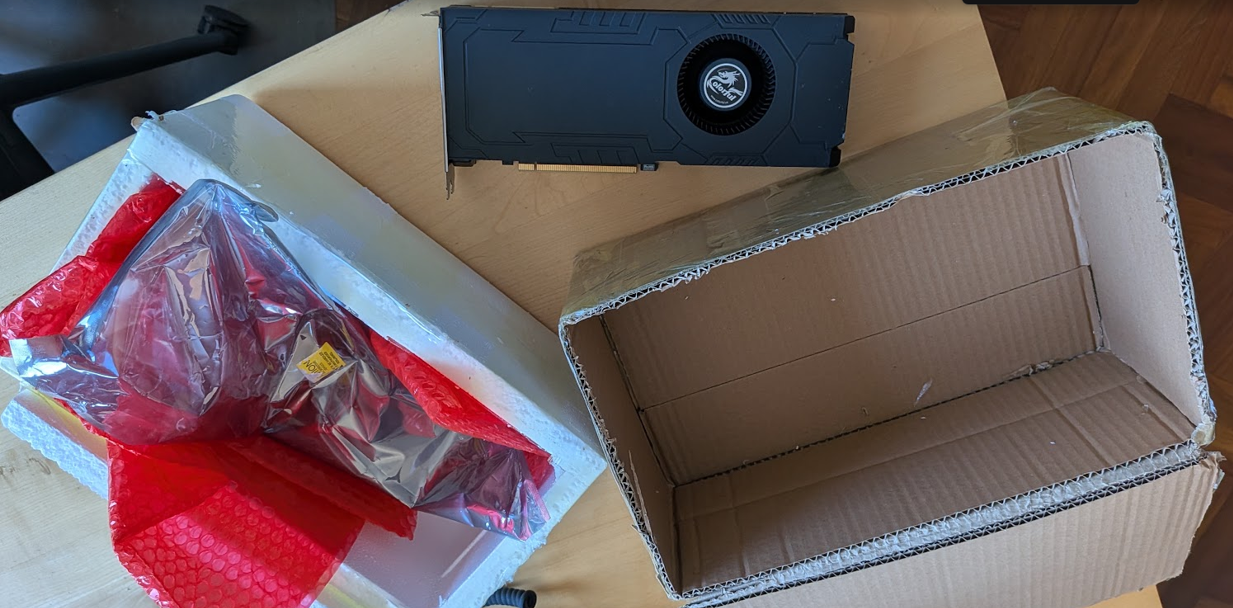
A stock RTX 2080 Ti has 11 GB of GPU memory. The 22 GB mod replaces its eleven memory chips with chips of twice the capacity and adjusts the card’s firmware. That makes these used cards interesting for AI applications, where memory capacity is often the first bottleneck.
However, incorrectly modified firmware can report 22 GB even when the additional memory is not reliably usable. A test should therefore write to all available memory and read the data back. Even a correctly reported capacity does not, by itself, prove stability under sustained load.
Ordering despite the block on German delivery addresses
We first tried Xianyu, China’s secondhand marketplace. In practice, we could not get past the requirement for a Chinese phone number. So we switched to Alibaba and ordered from Huateng.
There was another hurdle there: the seller lacked the German registration required for waste electrical and electronic equipment, so Alibaba would not accept a German delivery address. Instead, a Chinese freight forwarder’s address went in the address field, while our German address went under “Remarks.” The package reached us.
Conflicting address details like these can complicate buyer protection and the resolution of shipping disputes. What is actually covered depends on the specific contract and protection terms. We accepted that risk for the first order of around 890 US dollars. For a much larger purchase of CMP 170HX cards that we considered later, we were not comfortable doing so.
Several companies were involved in invoicing and shipping. For our bookkeeping, it was therefore important to use the order reference to clearly link the payment to the commercial invoice.
What importing adds to the bill
Graphics cards correctly classified under commodity code 8471800000 are subject to 0 percent customs duty. German import VAT of 19 percent still applies. Private buyers bear that cost. Businesses eligible to deduct input VAT can deduct it if the goods are imported for their business and they have the appropriate documentation.
Here are the actual figures for our first order:
| Item | Amount |
|---|---|
| Customs value, converted at the official customs exchange rate | 766.05 EUR |
| Customs duty | 0.00 EUR |
| Import VAT, 19 percent | 145.55 EUR |
| Carrier’s handling fee | 17.85 EUR |
| Payment to the carrier | 163.40 EUR |
| Of which recovered as input VAT | −148.40 EUR |
| Clearance costs after deducting input VAT | 15.00 EUR |
The 148.40 euros in input VAT consists of 145.55 euros in import VAT and 2.85 euros in VAT on the carrier’s handling fee. The remaining 15 euros is solely the net cost of customs clearance. The purchase price, shipping, and payment fees are additional costs.
The seller initially wanted to use an incorrect commodity code and declare too low a value for the goods. We had both corrected. For a business entitled to deduct all input VAT, underdeclaring the value provides no lasting tax benefit here. Private buyers would pay less import VAT, which they cannot recover. False declarations are illegal regardless.
Before shipping, it should also be clear who will handle the import and whose name will appear on the documents. For us, DAP with the goods imported in the name of our German limited liability company (GmbH) was the more straightforward option: the seller arranges transport, and we handle import clearance. Under DDP, the seller also handles clearance. If the goods are imported in the seller’s name, the tax paid is not automatically ours to deduct as input VAT.
CE conformity and the rules for waste electrical and electronic equipment also need attention, both when importing and if the cards are later resold. After the memory mod, the original conformity cannot be taken for granted. Importing for your own use is no blanket exemption, nor does every importer automatically become the manufacturer.
One card fails during its first load test
The first shipment arrived a little over a week after we ordered. One card ran without problems. The other initially seemed fine too, but crashed just a few minutes into its first load test. The failures became more frequent in subsequent tests, and soon the card was no longer detected properly at boot.
We spent a lot of time troubleshooting with different hardware, using the second card as a control. It worked in every test setup. Our repeated load tests may have made the damage worse; today, we would stop at the first error and check the cooling first. The initial failure had already occurred during the very first test, though. None of this allowed us to establish the cause.
The claim with Huateng and Alibaba
Huateng initially offered a replacement or a refund. Later, the seller required us to return the card and attributed the failure to high temperatures or improper use. We requested a refund and submitted our documentation of the failure to Alibaba.
The 80 °C measured at the GPU core tells us nothing about the temperature of the memory chips, however. Their temperature could not be read under Linux on this card.
Alibaba initially proposed a refund of 0 US dollars. After we challenged that proposal, the case was reopened. Rather than produce more evidence, we eventually sought a practical solution with the seller. Technical evidence of a defect does not automatically mean you can avoid returning the card.
Back to Hong Kong for 25.49 euros
Return shipping was cheaper than we expected. Instead of the 50 to 80 US dollars we had estimated, the DHL parcel to Hong Kong cost 25.49 euros. It took about ten days to get there.
We declared the card as returned goods, using its original value as the basis, rather than calling it a gift or assigning it a value of zero. Keep the purchase and return-shipping records. We also specified that any paid repair required our approval first.
The repair and the second order
A few days after the card arrived, the factory reported three “burned-out” memory chips and quoted 45 US dollars for the repair. We received no photos or measurements. The number of affected chips does not establish improper use; our own theory about the cause also remained unproven.
The seller’s warranty policy categorically excluded burned-out chips. Terms like these are worth reading before buying. We agreed on 40 US dollars for the repair, with the seller covering shipping back to us. That agreement was explicitly not an admission of fault.
We ordered two more cards. The new ones arrived via FedEx under DAP terms. The repaired card was shipped separately via DHL under DDP terms and arrived two weeks after the new ones. The repair was successful. Once the fourth card returned in late October, all four were running.
The cards in everyday use
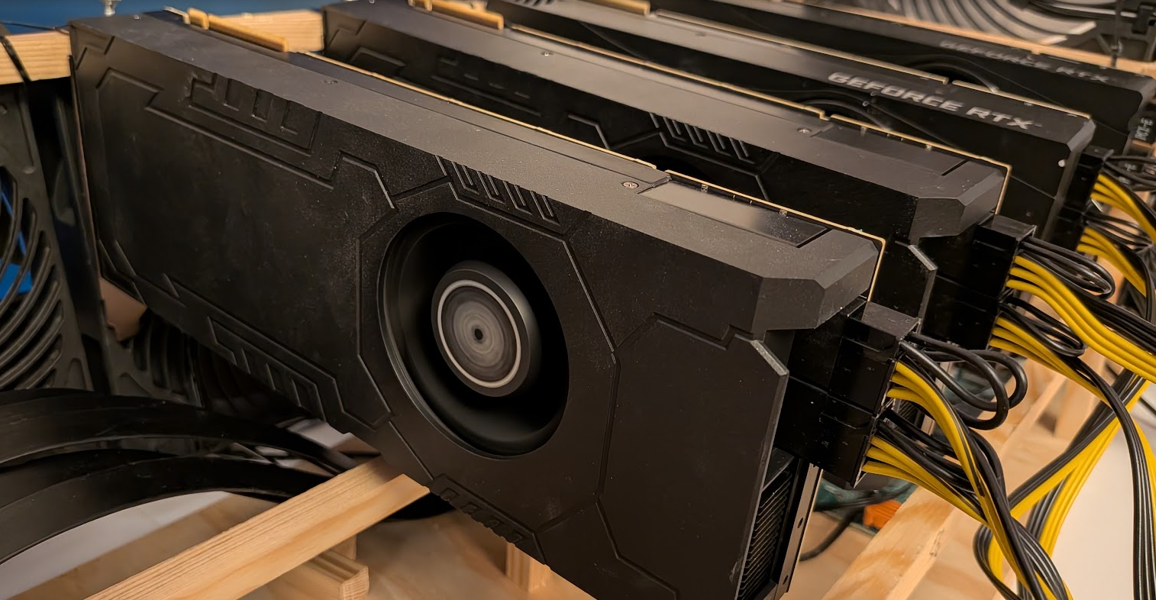
In use, we find the cards wonderfully quiet, even under load. At around 80 °C at the GPU core, though, they do run quite warm. Good ventilation is therefore important.
In the next articles, we will describe what the cards can do and how they perform.